Tell Us About...Reasons to Watch and Photograph Birds by the Water

I am fortunate to have joined a talented group of bloggers for the Global Writing Challenge. Each month, we write about a very broadly defined topic, and the responses are quite varied. The newly revised group includes Deb’s World, Marsha in the Middle, Rosie Amber, Suzy Turner, Once Upon a Time and Happily Ever After Again, and me.

This month, Rosie selected the topic of Water...which made me think about how much I like to watch and photograph birds by water.
Here are 8 reasons to watch and photograph birds in watery environments, especially if you are not an expert:
1 - The Open View
Large ponds, lakes, rivers, and of course oceans often provide an open and uncluttered view for seeing, identifying, and photographing birds. If you've ever tried to get a good look at a bird hopping around in a spring/summer tree with multiple layers of branches and leaves obscuring your sightlines, you'll know that an open field of view is pure gold.

Bird fact: Black phoebes are often seen around water because they have an insect-heavy diet and will also sometimes snatch small minnows from the water's surface.
Water fact: The Salton Sea is the largest inland lake in California; it extremely salty, currently with a saline level over 50% higher than the Pacific Ocean! This has caused fish and birds to die off there, but it still supports about 300 bird species. (I have seen 33 species there.)
2 - Great Background Color & Texture
For photographs in particular, the busy background of leaves in a tree or the boring background of dirt, bark, a wall, etc. can sometimes detract from your avian subject. Water provides beautiful color and visual texture to the background of the photograph without being overwhelming.

Bird fact: The plumes of the great egret were once worth twice their weight in gold in the late 19th century due to their use in decorating women's hats. After being nearly wiped out in the US, the bird made a comeback due to the efforts of conservationists and was chosen as the symbol of the National Audubon Society.
Water fact: The Minnesota River flows through a wide valley carved by the ancient glacial River Warren. It joins the Mississippi River at Fort Snelling (less than 5 miles from my home). The Minnesota Valley National Wildlife Refuge supports about 250 bird species. (I have seen 23 species there.)
3 - Cool Reflections in the Water
In addition to the smooth and interesting backgrounds water can provide your photographs, the reflections you can capture are also very cool to see: the bird(s), trees/leaves, sky, shorelines, buildings and structures, sunlight, insects, floating debris...the list goes on.

Bird fact: Buffleheads are the smallest diving ducks in North America, and they are so lightweight that they can take flight almost vertically from water.
Water fact: Upper Newport Bay is a 1,000 acre coastal wetland in Orange County in southern California. It supports about 200 species of birds. (I have seen 30 of them there.)
4 - Large Sized Birds
Many of the birds that live on or near the water are relatively large in size, making them easier to spot and to photograph (especially if you do not have a fancy lens).

Bird fact: Bald eagles (sometimes called "American eagles" because they are the national bird of the US) are often seen near water because they like fish, but they are opportunistic eaters who will steal food from other predators or eat carrion. (This is why Ben Franklin thought eagles have "bad moral character.") They build the largest nests of any bird in North America - up to 9 feet wide, 20 feet deep, and 4000 pounds.
Water fact: I live right next to the Mississippi River in St Paul, MN; the river in the Twin Cities supports about 300 bird species. (I have seen 31 of them around my apartment.)
5 - Can Allow a Close Approach to Birds
Obviously, it is not universally true that birds on the water will be close to you - I have certainly spent a lot of time looking through a spotting scope at distant ducks on a large lake or ocean! But you can often get close to the edge of the water in a way that you often cannot as easily with other natural features, and this proximity can be rewarded with excellent bird views, particularly if the body of water is small.

Bird fact: Mallard chicks are born on dry ground, stay in the next for about 10 hours to dry off and learn to use their legs, and then head into the water; they are capable of swimming and foraging for their own food (mostly insects) right away. They follow their mother for her protection rather than as a way of getting fed.
Water fact: The Maplewood Nature Preserve features 40 acres of marshes, supporting about 160 bird species. (I have seen 28 of them there.)
6 - Simple Behaviors
Even when the tree branches are bare, songbirds can be challenging to visually track, let alone photograph, because they engage in so many different behaviors - hopping from branch to branch (or tree to tree!), turning this way and that, flycatching, and moving around to the back side of the tree as soon as you get your binoculars/camera pointed at them. The movement is all over the place and the pace is frenetic. By comparison, waterbirds move slower and engage in more simple, basic behaviors that are easier to predict.

Bird and water "fact": Oops, he misinterpreted the dress code for the event at the wetlands. He was sure that everyone would be breaking out their smart colorful stockings for the party, but it was boring everyday grey stockings as far as he could see. While some might consider this sartorial miscalculation as a faux pas, he chose to rock his bright yellow legs without shame. His fancy dress made a splash on social media!
7 - Swimmers are Easy to Track
One of the challenges in trying to get a visual lock on a bird is that they move energetically in 3 dimensions - up/down, right/left, forward/back - often seemingly at random. But when you find swimming bird, you are in luck because they will mostly move in a straight line, which is easy to track. (Of course, it seems that as soon as you get a line on where they are and where they're going to be, they dive to feed; but that diving can sometimes be anticipated if you watch their pattern!)
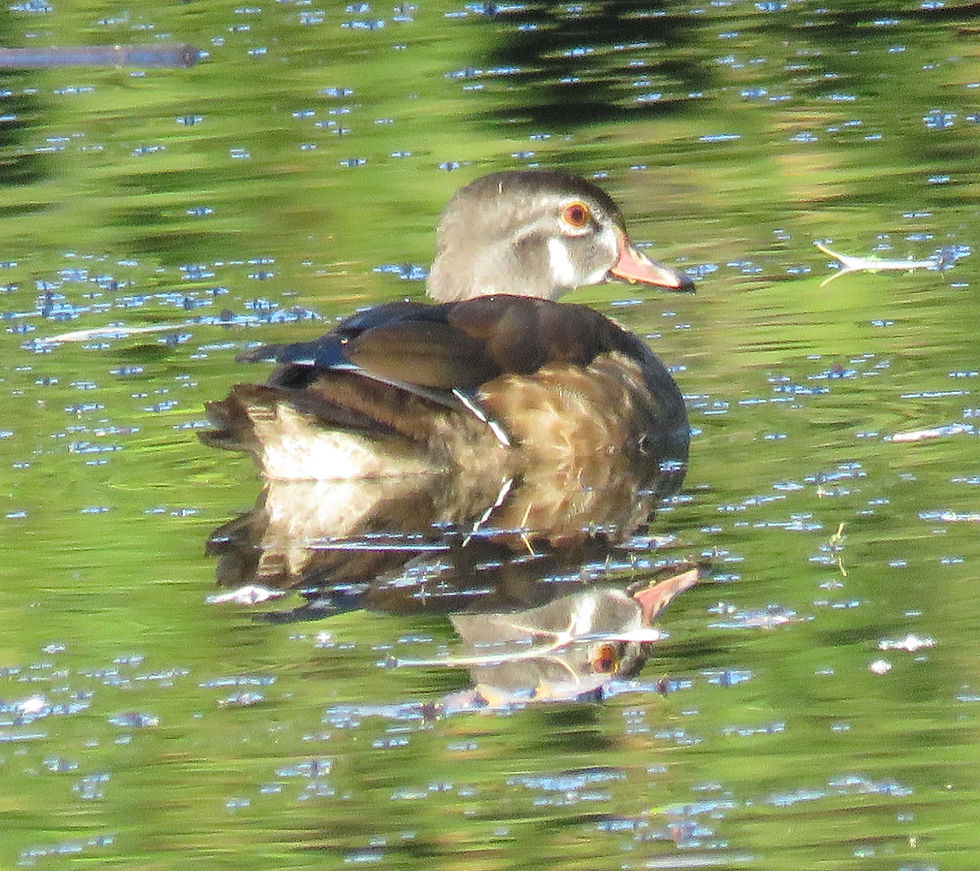
Bird fact: Wood ducks are an oddity among American birds, living up to the "wood" in their name. They nest in tree cavities rather than on the ground, often using holes made by pileated woodpeckers. This means that ducklings leap from their nests to the ground, surviving falls of 50 feet or more. Wood ducks have sharp claws that allow them to perch on branches.
Water fact: Wood Lake is a 150-acre urban nature preserve that supports over 200 bird species. (I have seen 39 of them there.)
8 - When Birds Stand Still, Time Stands Still
There is a special relaxed feeling you get when you know you have time to really look at a bird, identify it, and get a decent photograph of it. Whether it's a songbird perching in the open, a wading bird frozen in place as it awaits its prey, or a waterfowl that has decided to stand rather than swim, I love to see a still bird.

Bird fact: Instead of diving, blue-winged teal tip over in shallow water, submerging their heads to eat aquatic insects, vegetation, and seeds.
Water fact: The Minnesota River within the Minnesota River Valley NWR is placid and fairly shallow at 5 to 15 feet deep in its main channel (but is known for its high variability).
Check out what other bloggers have to say about water:
Debbie: Deb has shared quotes, photos and even poems to celebrate the precious resource of water in her life downunder.
Marsha: Marsha always planned to retire to the East Coast. Unfortunately, Marsha also had three kids to put through college so she lives in landlocked Indiana.
Rosie: Rosie talks about her love for the 'vitamin sea' that she gets from being near water and she tops it off with a few water themed books. This is Rosie's last post with the Global Writing Challenge; she will be missed as a part of this group, but you can still find her blogging at this link.
Suzy: Suzy writes about water and why it both soothes and unsettles her—pop over to read her take.
Leslie: This quote by Benjamin Franklin resonates with Leslie who lives in the Chihuahuan Desert of El Paso, Texas. "We know water to be precious, when the well is dry."
Now over to you...what are your thoughts on water? Do you live near water or far from it? Do you like to vacation in watery climes? Do you enjoy seeing or photographing natural water environments? Do you ever notice birds by the water?
Blogs I link up with are listed here.



pps - I just reread about the Wood Ducks and had forgotten about the ducklings leaping out of the trees. I have seen that on film and it is pretty amazing!
Thanks again for sharing all of your beautiful photos,
Barb :)
Sally, I love the facts you've shared about bald eagles. Aren't they incredible birds??! The first one I saw up close was when we were driving through Texas and we were packing the car at a hotel down in the Austin area. We had just moved our daughter to Texas (2016, before we got the call to move here). It wasn't 15' from me -- eating something dead in the grassy part of a carpark. I didn't think it was really a bald eagle, at first! Never knew they'd come right near people... Oh, and Benjamin Franklin thought we ought to have the wild turkey (smart birds, too) as our national bird. Still glad the eagle won that discussion, though!…
What beautiful captures and the facts that went with them were so interesting, Sally.
You make birdwatching really fun! #MMBC
Thanks for sharing with #pocolo. I love bird watching. it was one of my favourite things to do when we lived in South Africa.
We live right on the water so we see some birds-- mainly Canadian geese, common mergansers, mallard ducks, and bald eagles. We see herons, swans, and other birds of prey on occasion too.