Tell Us About...Dance, Music, and Varieties of Motor Control

I am fortunate to have joined a talented group of bloggers for the Global Writing Challenge. Each month, we write about a very broadly defined topic, and the responses are quite varied. The newly revised group includes Deb’s World, Marsha in the Middle, Suzy Turner, Once Upon a Time and Happily Ever After Again, Cat's Wire, Coffee and Cocktails at the Casa, and me.

This month, Suzy selected the topic of Dance...and yeah, this one actually made me laugh out loud because I am a terrible dancer.
Now in my experience, what typically happens when you say you are a terrible dancer falls into three categories of response:
(1) People rush to assure you that surely you're not (even if they've never seen you dance). I get it, some people lack confidence or are self-conscious about not being a great dancer, so they say they are terrible when they're really not. However, I am not looking for someone to reassure me in any way. I know what great, good, average, mediocre, and terrible dancers look like. I am a terrible dancer, definitely one of the worst dancers I've ever seen. I joke that I flunked out of the Al Gore School of Dance. I say this as a simple fact with no sense of shame. Nor am I given to any kind of general humility (as will become clear as I discuss many physical things I am actually really good at in this post).
(2) If people are willing to believe you that you dance poorly (or you have shown them abundant evidence that you are correct), they will assume that this is because you don't have a "sense of rhythm." Au contraire!
Rhythm is an interesting concept, and it isn't just one thing. Here's an example from my earliest days as a musician. I starting playing the flute in fourth grade, and I took to it very easily. (This makes sense to me because it's basically math made physical.) The biggest thing that my fellow newbies struggled with that I could do right away was the ability to tap one's foot to the beat of the music (like the quarter notes in 3/4 or 4/4 time) while playing a different rhythm on the instrument. The other kids would match their toe tapping to the rhythm of what they were playing rather than maintaining a steady beat with their foot. I found this very strange! Obviously the point of the foot tapping was to create a built-in metronome that told you where the beat was so you would maintain a steady pace when playing and get the timing of the notes right (e.g., eighths notes should be equal length with one on the down tap and one on the up tap)...and our instructor told us that specifically over and over again. But apparently many people find it really challenging to do one thing with their hands/mouths and a different thing with their feet without practice!
So in my case, I have a good sense of rhythm when listening to or playing music. I can easily tell the time signature and beats of a piece of music I hear and move my hand precisely along with the beats (e.g. keeping or beating time using standardized geometric conducting patterns like the triangular 3/4 pattern or cross 4/4 pattern). My intern Gemini AI says that this is an example of sensorimotor synchronization, which relies on the specific rhythmic skills of predictive timing, tempo tracking, and internalizing the pulse of the music...and is evidence of having a good sense of rhythm.
Through junior high, I was always the best musician in my school band - not just of the flute players but of all players. When I entered high school in 10th grade, I shocked the older students by being first chair (which they had assumed would go to one of the seniors who was quite good and under normal circumstances would have been a worthy first chair). It turns out I was the second best musician in the band that year; another 10th grader I didn't yet know because he attended a different junior high was a truly great trombone player. Trombone Guy and I carried the band through marching and concert seasons respectively. Seriously, every piece we performed during concert season would have a showy and difficult flute solo that I would have to perfect, and it actually burned me out on school band. But that's a story for another day...In any case, I haven't played music with any regularity since I started college, but I haven't lost the ability to find the beat in music and "play conductor" to it.
(3) When people discover that you can't dance but you're a very good musician, they find this contradiction baffling! I attended prom each of the three years in high school, and each year, multiple people got to experience this cognitive dissonance first hand when they would ask me to dance to a fast song and saw my pitiful freestyle party dancing in action. (It was much easier to slow dance, and amazingly high school aged boys are quite happy to go along with this.) One of my best friends, who was an adequate clarinet player and a pretty great dancer, marveled that I could play music with complicated rhythms so easily but couldn't dance to the beat to save my life. (True fact. I would be dead if that had been some kind of prom night horror dance reality TV show.)
Now there are people who are bad dancers and don't know it, but I am not one of them! That same innate sense of rhythm made it impossible for me not to feel how much my body movements were not lining up with the beat of the music, and it felt weird and unpleasant.
My intern Gemini AI investigated this disconnect between my ability to play music well but dance poorly and explained it this way:

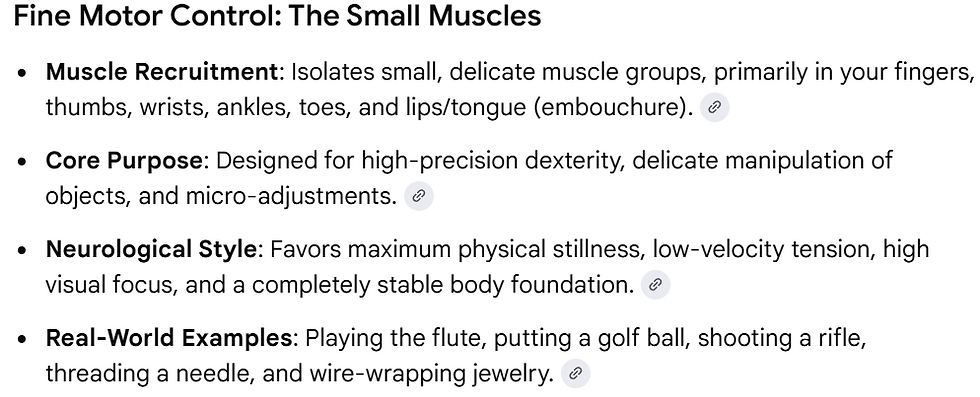
So it's not a matter of "rhythm" so much as it is the difference between fine motor control and full-body motor control, which is often called fine vs. gross motor control (where "gross" means large, from the Old French word "gros"; the German word "groß" is a linguistic cousin).
I spent some time chatting with my intern about my strange experience of participating in different sports and what I did well, okay, and badly. And from this conversation I learned that there are three aspects of motor control that influence how a person performs (in addition to other factors like stamina, strength, speed, etc.). As you read the descriptions of these three aspects, consider whether you think you are better at one than the other or are equally good (or bad!) at both. Then we'll look at some examples of sports/activities (or parts of sports/activities) and where they fall on these three aspects...along with my own experiences of them.
#1: Gross versus Fine Motor Control


#2: Closed-loop versus Open-loop Motor Control


#3: Structured versus Chaotic Environments


Here are some activities and where they stand regarding these three aspect of motor control. How well do you do them? Is there a pattern emerging as to which aspects you are stronger and weaker in?
Playing a musical instrument - Fine, Closed-loop, 100% Structured
As I discussed above, I was very good at this.
Golf, putting - Fine, Closed-loop, 100% Structured
At my first ever golf lesson (through city parks & rec), I was the only student who didn't already play golf (we introduced ourselves to the group with an explanation of our experience). Imagine the surprise of everyone but my husband when I immediately was able to sink putts where everyone else struggled. I admit that I had played mini golf a few times before this, and yeah, I was good at that too. My best friend's boyfriend was a big mini golf player who bragged about his prowess and was then humbled as I quietly kicked his ass on my perhaps third ever experience playing. It was both funny and sad.
Golf, teeing off - Gross, Open-loop, Structured with a massive burst of explosive chaotic energy
At our second golf lesson, we learned to hit off the golf tee...and I was bad at it! And in a way that I could tell was not just due to lack of experience or practice, but just inherently bad. So I did not continue to take golf lessons as I recognized this feeling of not being able to coordinate all the parts of my body from...
Tennis, serving - Gross, Open-loop, Structured with a massive burst of explosive chaotic energy
My dad was an excellent tennis player, and I did learn the basics of tennis as a child, but I never got so far as to learn to serve. When I took tennis for PE in college and later took tennis lessons (through city parks & rec), I did learn to serve...and learned that I am terrible at that too! As a point of comparison, my husband (who pretty fairly considers himself not athletic in general) developed a reasonable serve by the end of the lessons but mine was quite weak and I could feel how off I was when I did it (just like dancing).
Tennis, groundstrokes (forehands, backhands) and baseline game - Gross, Closed/Open-loop hybrid, Chaotic with structured foundation
I would never be a great tennis player, but I did have decent forehands and backhands. In the parks & rec lessons, we were taught a one-handed backhand, but when the instructor saw my two-handed backhand I learned as a kid, he said "That's great, don't change a thing!"
Tennis, volleys at the net - Gross with fine motor finish, Open-loop, Structured with strong element of controlled chaos
This turned out to be the best part of my tennis game. In college, when our instructor wanted to demonstrate the volley, I was the lucky student who got to try it in front of the class. I hit the ball at a ridiculous and unreturnable angle, and the coach said "O-K, that's a volley." I did it a few more times, targeting different spots with unreturnable volleys. The coach told the class that it's actually harder than I made it look. When I wanted to win a point, going to the net and hitting the ball to a place my opponent couldn't get to was my strategy. I particularly liked hitting the ball so that it was so low to the ground that it was hard to get your racket on it. I did the same thing with...
Racquetball, serving - Gross, Open-loop, 100% structured
Because racquetball is an even faster game than tennis, it can get really chaotic, but I exceled at the serve. I mean, a couple weeks into the class, my regular opponent could not return my serve at all. I asked him what was up and he said "Would you like me to show you what your serve does?" I don't remember the details, but the ball ends up really close to the ground in the back corner; it was a valid serve but because the ball was so low to the ground, it was hard to return. I tried serving differently and he said "OK, that's the same but now it's to my backhand so it's even worse." I rode that serve to victory against so many opponents who did not learn to return it in the length of a game. Later, when my best friend and I played a few times a week, she would always serve, even if I won the point, because she never figured out how to return that crazy serve. My intern thinks I was successful with this because I treated the structured serve (which requires much less full body coordination than a tennis serve) like...
Basketball, free throws - Fine, Closed-loop, 100% Structured
Remember my two-handed backhand? I had a similar experience trying out for the 6th grade school team. I walked up to the line and put the ball in both hands, and the girls who didn't know me from two years of Salvation Army ball laughed while my prior teammates and opponents shook their heads. I proceeded to sink 10 free throws in a row like a machine that was build to throw free throws. Of course, that was nothing to me. I could throw free throws for literally hours without missing (and I frequently did at home). Foul me while I shoot at your peril.
Basketball, layups - Gross, Open-loop, Chaotic
This was my poorest shot in basketball; I could do it, but it wasn't as reliable as shooting from the field, let alone free throws.
Target shooting (marksmanship) - Fine, Closed-loop, 100% Structured
The only times I have fired an actual gun was when a friend in high school had me over to his place in the country to shoot cans. It's weird that people make a big deal about shooting a stationary target because all you have to do is point at the thing and shoot it. After hitting all the cans in a row, my friend's younger brother jumped out from hiding behind a tree and was extremely excited at my ability (my friend played it nonchalant but yeah). The brother wanted to see how I'd handle a bow and arrow but my friend's hunting bow had a draw weight too strong for me to pull. But I later had my chance...
Archery - Fine, Closed-loop, 100% Structured
I was maybe 30 before I ever shot a bow and arrow; this was at a work retreat with a group of a dozen people and an instructor. When it was my turn, I aimed and shot and hit just outside the bullseye. The instructor said "Oh, so you've done this quite a bit before." "No, actually it's my first time holding a bow" I said. Everyone else did not hit what they were aiming for, and after missing, one guy said that he wanted to try my bow because it's obviously better than his (note: the bows were identical and handed out randomly to us). The instructor looked at me like "Yeah right" but I let him try, then everyone try, and someone said "Um, I don't think it's the bow."
Swimming - Gross, Closed/Open-loop hybrid, 100% Structured
I did not naturally take to the water. I did group lessons one summer as a kid, and while I got more comfortable in the environment, I didn't really learn to swim. Luckily my dad traded tennis lessons for a classmate of mine in exchange for his mom teaching me to swim in their pool. I did learn, though I never got very good at it. I found surface swimming difficult because turning my head to breath was one bit of full-body coordination too far; I would lose my rhythm and breath in water (which I HATED). I did get pretty good at swimming under water, though, which my intern says is because not having to breathe eliminates the Open-loop aspect, making it Closed-loop. Similarly, my diving was terrible (and it was terrifying to me) because it is 100% Chaotic and Open-loop.
Gymnastics - Gross, Closed/Open-loop hybrid, highly Structured
I took gymnastics for a few years in elementary school and I wasn't terrible at it. Balance beam was my best event, probably because it is most reliant on fine motor skill and had more structured elements. I don't remember whether vault or floor was my weakest event, but I think floor - I was terrible at any "dance-like" aspects of it. The way leveling worked was to achieve a level in an event, you had to demonstrate mastery in specific skills for that event/level. I progressed faster in beam and uneven bars than the other two. Once I completed the final foundational level in my weakest event (I had higher levels in the others), it was time for me to join the competitive team to continue my training. I didn't want to compete, and I knew I had no future in gymnastics (I was a tall kid), so I left at that point. It's actually weird to think about things I was able to do - like a one-handed cartwheel on the beam - that seem crazy to me now.
Fencing, epee - Gross/Fine motor hybrid, Closed/Open-loop hybrid, Structured with Chaotic elements
In addition to tennis/racquetball, I took a semester of fencing in college, where I was one of 3 girls in the class. It was actually quite a grueling class; I remember one day our area of the gym was closed so we spent the entire time running stairs. Luckily I had decent height (5'8") and very good leg strength, so I was able to compete with the guys. My signature move was scoring off the riposte - you parry (block) your opponent's blade (that they have thrust at you) and immediately counter-attack for a touch, pinning/pressing against their blade as you push forward so they can't get back at you. My intern says that it makes sense that this was my winning move because the parry is a Closed-loop situation and the riposte is a Fine motor strike from a stationary position; it basically turns the chaos of fencing into a structured routine.
Rock climbing, top rope - Gross with hyper Fine finish, Closed-loop, Structured with chaotic elements
I only went rock climbing once (in my early 20s) when visiting a friend, but I enjoyed it and was pretty good at it. It seems to mostly draw on leg strength, which was good for me (and most women, compared to upper body strength). I borrowed a pair of climbing shoes from a professor at Princeton who often climbed with this group, and there was this whole conversation as I climbed about how I looked exactly like him in how I moved and how I held my body at various angles to the rock face. I was very amused to have the "look" of an experienced climber having no training or experience, and it was very funny when my friend told everyone that I was wearing that professor's shoes. The shoes may have given me a bonus to climbing ability but they did not turn me into one of the greatest thinkers of the modern world.
Jump rope, endurance style - Gross, Closed/Open-loop hybrid, Structured
Double dutch with fancy tricks is another story, but I was a marathon one girl/one rope/one rhythm jump roper. In elementary school, it was a dead lock guarantee that I would come home from field day every spring as the #1 blue ribbon winner in jump rope. (I also won the 1 mile foot race despite, and indeed because of, my agonizingly slow running speed - other kids would sprint and wear themselves out while I would tortoise run my way steadily to the end. I would have competed in longer races but 1 mile was the max at field day. I was fortunate in both jump rope and running that I had basically endless stamina.) In 6th grade, I set a school record in jump rope during and after PE class. I kept going to so long that they eventually had to stop me and send me back to class. I don't know how long I jumped rope that particular time, but I could easily jump rope for hours at home without missing a beat.
Four Square - Gross with Fine touch, Closed-loop, Controlled Chaos
In elementary school, the four square court was my world, you just lived in it. I was a ruthless player, high Queen of the Square, and no one will defy me! Thinking back to my domination of that court, I almost scare myself.
Here are some Gross, Open-loop, Chaotic activities:
Boxing, wrestling, judo, hurdles, discus/javelin throwing, skateboarding, dodgeball, soccer (what the world calls football), rugby, water polo, ice hockey, ultimate Frisbee, paintball, downhill mountain biking, surfing, whitewater kayaking, baseball/softball (1 year of t-ball revealed that this was not going to be my sport), and...yes...DANCING!
After our conversation, I asked my intern to generate a profile of my motor skills, and this all seems true (though I would argue that my skills specifically at shooting pool and swimming are only okay, I think the points it makes with those examples are correct):


Thanks for taking a long wander through music, dance, and the motor skills and motor learning environments where I excel and struggle.
Now check out what other bloggers have to say about dance:
Debbie: On vacation through July 28.
Marsha: When Marsha was teaching, her students would beg her not to sing (she still did). But, when it came to dancing, they were all for it. I mean, who doesn’t want to see their teacher make a complete fool of herself? Read Marsha’s post to discover all the goofy things she and her class used to do!
Suzy: Suzy shares why dancing has meant so much throughout her life, and how one night on the dance floor changed everything forever.
Leslie: For Leslie, this month's prompt - dancing - brings lots of things to mind: a favorite memory, ballet, and a great Ginger Rogers quote. Which will she write about?
Cat: Cat has ambivalent feelings about dancing.
Amy: Amy shares thoughts on dance through quotes and lyrics as pertaining to her life history thus far.
Now over to you...are you a dancer? Do you have any particular types of dance or places to dance that you like or dislike? Where do you think you fall on the motor skill areas of Gross/Fine, Open/Closed-loop, and Chaotic/Structured environments? Are there sports/activities that you have a history of exceling in or doing poorly? Do you favorites line up with your strengths?
Blogs I link up with are listed here.



I would not call myself a dancer, but I do enjoy bopping to the beat. :) I, too, can pick out the time signature of any song. I enjoy music! And bopping. ;) Thank you for sharing this with us at the Will Blog for Comments #88 linkup. Wishing you a lovely week ahead. See you at WBfC #89 when it opens Monday morning.
This was so interesting! I knew about gross versus fine motor but not the more intricate details of the different types of gross motor. I am a pretty good dance (though I sometimes lack the confidence) but have zero hand/eye coordination.
WOW, Sally, this is really fascinating! I have to say I loved reading about your first foray into golf putting and the bow and arrow — specifically, how the men thought they were better at it than you, and even blamed the bow!!!! That's brilliant!
I'm not very good at sports, generally. At school, I hated PE. The only sports I was half decent at were throwing things (javelin, shotput etc). I was good at dancing but only when I could freestyle. If I had to learn other people's moves, I was pretty useless lol!
My dad is a terrible dancer. He always said he had two left feet and I have seen him try, once, and he was right.…
Holy cow, Sally! You have tried and done so many things in your life! I would not worry about the not being able to dance one little bit when you excel at so many others. It is interesting that rhythm and dancing really don't relate. I play in a handbell choir (don't read music at all...I play the bottom note and the line note of the treble clef) and have to count in my head to keep the rhythm. There are some songs I can play without counting, but they are few and far between. And, if it has been some time between practices, it's like I've never heard the music before. This was such an informative post...give your …
I would argue if you're having a good time, you're a good dancer. I don't think dance is performative (on a dance floor) - it's not about how you look, it's about how you feel!